Gutter Parts and Fittings
Gutter Accessories That Keep Water Moving Away From Your Home
Gutter accessories are the hangers, outlets, downspouts, elbows, end caps and guards that turn a trough into a drainage system. Permanent Metal Roofing Systems supplies and installs them in matching metals and finishes on gutter jobs across Dallas-Fort Worth.
- 20+ years of experience
- Lifetime limited warranty
- Free written estimates
Which Gutter Accessories Does a Metal Gutter System Need?
Every gutter system needs hangers to hold it, outlets to drain it, downspouts and elbows to carry water down, end caps to close it, and a safe discharge point. Leaderheads, expansion joints and leaf guards are added where the roof calls for them.
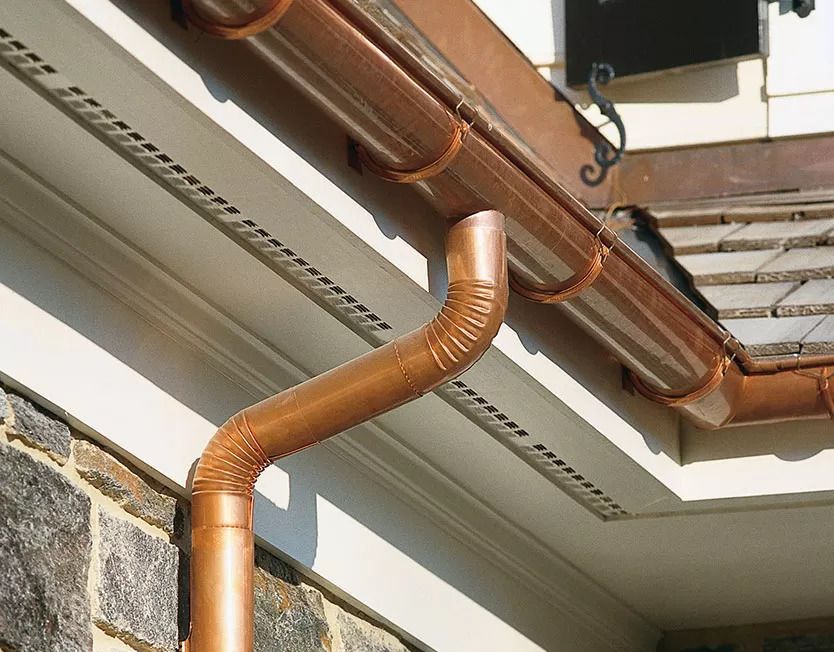
The parts matter as much as the trough. A 6-inch gutter with one undersized outlet still overflows. A strong gutter on weak hangers still sags. We specify accessories with the same care as the gutter itself.
Every part matches the gutter metal. Copper systems get copper hangers and soldered copper fittings. Aluminum and painted steel systems get color-matched parts, so nothing stands out on the house. Custom box gutters and their fittings can be bent in any finish on our metal roof color chart.
Gutter Accessory Specifications
Here is how the parts line up with the gutters we install.
| Spec | PMRS gutter accessories |
|---|---|
| Materials | Aluminum, galvanized steel, copper and stainless, matched to the gutter |
| Thickness | Matched to the gutter: aluminum .025 to .032, galvanized steel .018, heavier copper and stainless for custom work |
| Downspout profiles | Rectangular and round, smooth or corrugated |
| Elbows | A and B styles for rectangular downspouts; round elbows for half-round systems |
| Finish | Color-matched paint on aluminum and steel; natural copper and stainless |
| Ratings | No standalone ratings; capacity comes from sizing the whole system |
| Warranty | Ask for the manufacturer and installation terms with your quote |
| Best for | New gutter systems and upgrades to undersized or failing parts |
Hangers and Outlets: Which Parts Carry the Load?
Hangers hold the gutter’s weight, and outlets decide how fast it drains. Most overflow and sagging traces back to one of the two.
K-style gutters use hidden hangers that clip inside the trough and screw into the fascia. Half-round gutters ride in brackets or on straps, which can be decorative. A gutter full of storm water is heavy, so we space hangers tighter than the bare minimum, especially near valleys.
An outlet, also called a drop, is the opening where water leaves the gutter for the downspout. Its size must match the downspout, and long runs need more than one. Where a valley dumps into a corner, we add an outlet close by, so the corner does not overflow in a thunderstorm.
Smooth or Corrugated Downspouts, A or B Elbows?
Smooth downspouts give a clean, modern look. Corrugated downspouts have ribbed walls that stiffen them and let them flex a little if water freezes inside.
Rectangular downspouts come in sizes such as 2 by 3 inches and 3 by 4 inches. The larger 3-by-4 size pairs with 6-inch gutters and carries much more water. Round downspouts serve half-round systems.
Elbows turn the downspout around the eave and at the ground. An A elbow bends toward or away from the wall. A B elbow bends left or right along the wall. Most houses use A elbows to bring the spout back under the overhang, and a B elbow where a spout must jog around a window or meter.
Hard freezes are rare here but real. During Winter Storm Uri in 2021, ice-clogged gutters were among the main causes of roof-edge leaks. Corrugated spouts and clear outlets help on the nights that matter.
Leaderheads, End Caps, Miters and Expansion Joints
These are the fittings that close, turn and protect the system.
- Leaderheads. A box at the top of a downspout that collects water from a scupper or gutter outlet. It adds capacity and a finished architectural look, and it is common with box gutters.
- End caps. They close each end of the trough. We solder them on copper and stainless, and seal and rivet them on aluminum and steel.
- Miters. Inside and outside corners where runs turn with the house, sealed or soldered to match the gutter.
- Expansion joints. Long runs grow and shrink with DFW temperature swings. A joint lets each side move, so seams and end caps do not split.
Do Leaf Guards Make Sense in DFW?
Leaf guards are worth it under heavy tree cover and optional in open yards. Live oaks shed in spring, and pecans, pines and cottonwoods add their share through the year.
Options range from simple screens to micro-mesh panels. National cost guides put DIY screens at roughly $3 to $5 per 3-foot section, and installed micro-mesh at about $15 to $25 per linear foot as of 2026. Micro-mesh blocks the most debris but still needs an occasional rinse.
On a metal roof, a guard must not slide under the panel edge or lift the eave trim. We choose guards that clip to the gutter itself, so the roof edge stays untouched. Guards also help in hard freezes by keeping out the debris that traps ice.
Downspout Extensions and Drains for Clay Soil
Where a downspout ends is as important as the gutter above it. DFW’s expansive clay reacts to water, and a downspout that empties at the slab keeps one side of the foundation wetter than the rest.
- Splash blocks spread water and slow it down on sloped yards.
- Hinged or roll-out extensions carry water farther from the slab.
- Buried drain lines with pop-up emitters move water out to the yard where local rules allow.
Upgrade the Parts or Replace the Gutters?
If the trough is sound and only the outlets are undersized, adding outlets, larger downspouts and better hangers can fix it. If the gutter is too small, rusted through or pitched wrong, replacement costs less over time.
With a new metal roof, we usually recommend new gutters too, so the eave trim and gutter are set as one detail. See metal gutters for sizes and styles, eave flashing for the roof edge, and metal roofing accessories for the roof side of the system.
Gutter Accessories FAQ
What is the difference between A and B elbows?
An A elbow bends toward or away from the wall, and a B elbow bends left or right along it. Most downspouts use A elbows at the top to come back under the eave, and a B elbow only where they must jog sideways.
Are corrugated downspouts better than smooth?
Corrugated walls are stiffer and flex slightly if ice forms inside, so they resist splitting. Smooth downspouts look cleaner on modern homes. Both carry about the same water for the same size.
How many downspouts does my gutter need?
It depends on the roof area draining to each run and the downspout size. Long runs and runs fed by valleys need more. We size outlets and downspouts run by run instead of using one rule of thumb.
Do you sell gutter accessories to contractors?
Yes. PMRS supplies materials to contractors and builders, including custom box gutter parts bent in our shop. Contact us with your list for pricing.
Can accessories match copper or stainless gutters?
Yes. Copper and stainless systems get matching hangers, outlets, elbows and soldered end caps. Mixing metals would cause corrosion, so we keep every part in the same metal.
Get Your Free Metal Roof Estimate
Tell us about your roof and a Permanent Metal Roofing Systems specialist will follow up to schedule your free estimate. No pressure, no obligation.
Prefer to talk now? Call (469) 466-2421.
Small Parts, Big Difference
Get a free estimate for gutters and accessories sized to your roof, or a complete PMRS metal roof with drainage planned in.