Hip and Ridge Trim
Metal Roof Hip Cap and Ridge Trim Bent to Your Roof’s Pitch
A metal roof hip cap seals the outside corners where roof planes meet, and a ridge cap seals the peak. Permanent Metal Roofing Systems bends both in-house to your exact pitch, seats them on Z-closures and vents the ridge when your attic needs airflow.
- 20+ years of experience
- Lifetime limited warranty
- Free written estimates
What Is a Metal Roof Hip Cap?
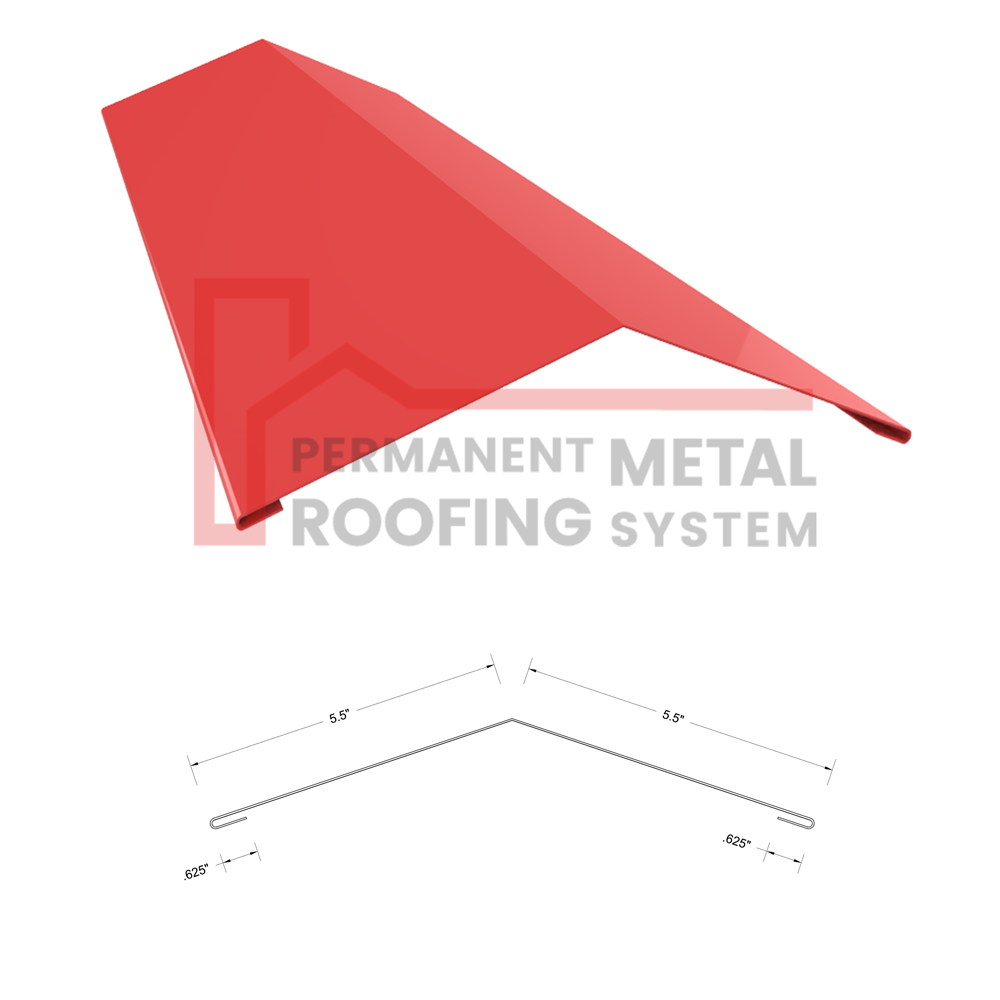
A hip cap is the formed trim that covers a hip, the sloped outside corner where two roof planes meet. A ridge cap does the same job along the level peak at the top of the roof.
On a standing seam roof, neither cap is screwed through the panels into the deck. The panels stop just short of the hip or ridge line. Z-closures are fastened to the panel flats over butyl tape, and the cap fastens to those closures.
The deck stays sealed, and the panels keep their freedom to move. Because we bend caps to the pitch measured on your roof, they sit tight on both planes instead of gapping at one edge.
Hip Cap Specifications
Hip and ridge caps are bent from the same coil family as the panels they cover.
| Spec | PMRS hip and ridge caps |
|---|---|
| Material | Same metal as the panels: Galvalume steel, aluminum, copper or zinc |
| Gauge or thickness | 26, 24 or 22 gauge steel; .032 or .040 aluminum; 16 or 20 oz copper; .7 or .8 mm zinc |
| Profile | Center break bent to the measured pitch, hemmed edges, closures fitted between the panel ribs |
| Ventilation | Closed with a solid Z-closure, or vented ridge with a perforated Z-closure |
| Finish | PVDF (Kynar 500 or Hylar 5000), Tedlar PVF film, crinkle or SMP |
| Ratings | Not rated on its own; wind and impact performance come from the full roof system |
| Minimum slope | Follows the panel: 3/12 for snap lock, 1/2:12 for mechanical lock |
| Warranty | On PMRS standing seam roofs, part of our Lifetime Non-Prorated Limited Warranty; finish warranted by the coil coater |
| Best for | Hip roofs, ridges and any roof where trim must match the panels exactly |
Vented or Closed: Which Ridge Does Your Roof Need?
Choose a vented ridge when your attic is designed to breathe, with intake at the soffits and exhaust at the peak. Choose a closed ridge when the attic is sealed, the ceiling is vaulted with no vent channel, or the ridge is too short to matter.
A vented ridge on a PMRS roof is an add-on at $45 per linear foot. It uses a perforated Z-closure and a filtered gap at the deck. Hot attic air escapes, while wind-driven rain and insects stay out.
In DFW, attic heat is the main reason to vent. The region typically logs about 20 days a year at or above 100 degrees, and an attic under a sunny roof runs hotter still. A ridge vent only works with matching intake at the soffits, though. Exhaust without intake can pull conditioned air out of the house.

Hips are usually closed. Most exhaust happens at the highest point, and a hip carries water diagonally along its full length. A solid Z-closure on butyl tape gives the hip the tightest seal.
If your home has spray-foam insulation on the underside of the deck, the attic is sealed by design. In that case we close the ridge too, matching what the insulation contractor intended.
What Do Z-Closures Do Under a Hip Cap?
Z-closures are the hidden seal under every standing seam hip and ridge. They block the open ends of the panel seams and give the cap a solid place to fasten.
Each closure is a Z-shaped strip bent to fit between the panel ribs. It sits on butyl tape, fastens to the panel flat and is sealed where it meets each rib. The cap then fastens to the upright leg of the closures on both sides, so no cap fastener reaches the deck.
The vented closure is perforated, so attic air can pass up under the cap. The solid closure is used on hips and closed ridges. Both come off the same brake as the cap, in the same finish.
This detail is also why a well-built standing seam ridge rarely leaks. The weather line is two layers deep. The cap sheds water, and the sealed closure stops anything the cap lets past.

How Does PMRS Install Hip and Ridge Caps in DFW?
We bend caps to the pitch we measure, then install them as the last metal on the roof, in this order:
- High-temperature underlayment wraps over the hip or ridge line before the panels go on.
- Panels are cut along the hip or stopped short of the ridge, leaving a vent gap where one is specified.
- Butyl tape and Z-closures are fastened to the panel flats and sealed at each rib.
- Caps are lapped away from the prevailing wind and fastened to the closures, never to the deck.
- Cap ends at hip tops and ridge ends get formed end closures, not a blob of caulk.
Ridges and hips sit in the highest-uplift zones on a roof. That matters in North Texas, where recent storms brought straight-line winds above 75 mph to parts of the metro. Caps that ride on closures and lap tightly stay put.
Hail is the other test. Caps are formed from the same gauge as the panels, so they dent no more easily than the field of the roof. Our 24 vs. 26 gauge guide explains how thickness affects hail resistance.
Do Hip Caps Match Metal Shingle and Stone-Coated Roofs?
On standing seam, we bend caps from the same finish as the panels. Metal shingle and stone-coated steel roofs work differently, because their makers supply matching hip and ridge pieces designed for their own interlocks.
On those systems we install the manufacturer’s trim, which helps keep the manufacturer’s warranty intact. See metal shingles and shakes and stone-coated steel roofing, or compare finishes on our color chart.
Hip Caps vs. Valley and Eave Flashing
Hip caps cover outside corners, where water runs away on both sides. Valleys are inside corners, where water runs together, so they need a pan rather than a cap. Eave flashing finishes the bottom edge and anchors the panel ends.
All three are bent in our shop and installed by our crews. See custom metal flashing for valleys and walls, and eave flashing for the lower edge. Sealants and closures are covered on metal roofing accessories.
Hip and Ridge Cap FAQ
Does a metal hip cap need to be vented?
Usually not. Hips are normally closed with solid Z-closures, and the attic exhausts at the ridge. A vented ridge makes sense when the attic has soffit intake to balance it.
How much does a vented ridge cost on a metal roof?
On a PMRS roof, a vented ridge is an add-on at $45 per linear foot. The rest of the hip and ridge trim is included in the installed roof price.
Can ridge caps be screwed straight through the panels?
Not on standing seam. Screws through the panel flats into the deck pin the panels and open holes in the weather line. We fasten caps to Z-closures instead, so the panels stay free to move.
Why is my metal ridge cap rattling or loose?
Loose caps usually trace back to missing closures, deck fasteners that worked loose as the panels moved, or laps facing into the wind. Have a rattling cap checked soon, because the next storm can lift it.
Will the hip caps match my roof color?
Yes. We bend caps from the same metal and finish as the panels, so color and weathering match. Contrasting trim is also possible if you prefer it.
Get Your Free Metal Roof Estimate
Tell us about your roof and a Permanent Metal Roofing Systems specialist will follow up to schedule your free estimate. No pressure, no obligation.
Prefer to talk now? Call (469) 466-2421.
Finish Your Roof at the Top
Get a written estimate for a PMRS metal roof with matched hip caps, ridge trim and venting planned for your attic.