
Gutters and Drainage
Metal Gutters Sized for Dallas-Fort Worth Downpours
A metal roof sheds water fast, so its gutters need to be sized, pitched and finished to keep up. Permanent Metal Roofing Systems supplies and installs metal gutters across Dallas and the wider metro: seamless K-style, half-round, custom box gutters and stainless Yankee gutters.
- 20+ years of experience
- Lifetime limited warranty
- Free written estimates
Which Metal Gutters Does PMRS Install?
We install four families of metal gutters. The right one depends on your roof area, your architecture and how visible you want the gutter to be.

Seamless K-Style
The everyday workhorse, in 5- and 6-inch sizes. Aluminum comes in .025, .027 and .032 thickness, and galvanized steel in .018. Runs are formed to the length of each wall, so there are no seams to leak mid-run.
Half-Round
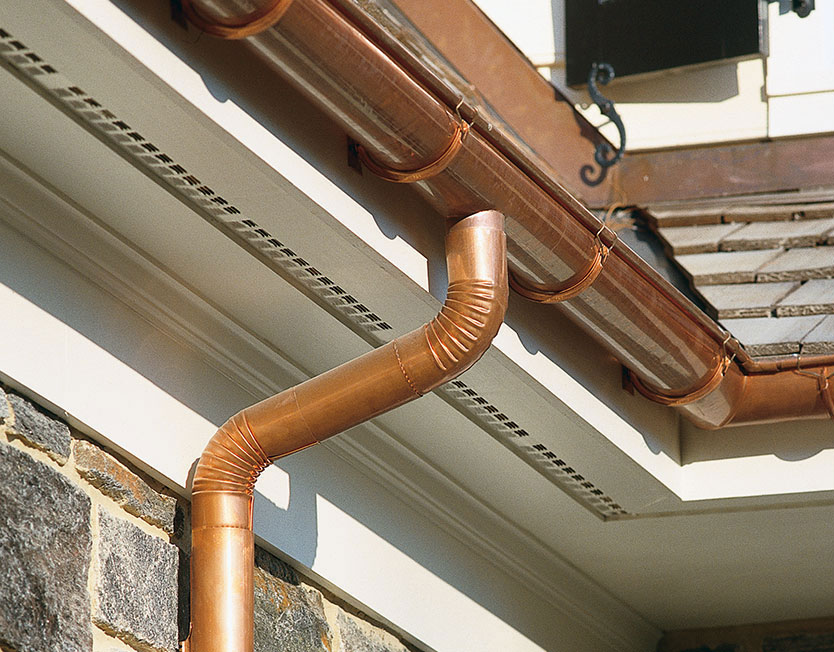
A rounded trough in 5- and 6-inch sizes, hung on brackets and drained by round downspouts. Half-round suits traditional, historic and copper-accented homes.

Custom Box Gutters
Square-profile gutters bent in our shop in 6-, 7- and 8-inch sizes, and larger on commercial work. They handle big roof areas and suit modern and commercial buildings.
Stainless Yankee gutters are the fourth option. They are built into the roof edge instead of hanging from the fascia, as described below.
How Big Should Gutters Be for DFW Rain?
For most homes with a metal roof in DFW, 6-inch gutters with 3-by-4-inch downspouts are the safe choice. Published sizing guides put a 6-inch gutter at about 67 percent more water per foot than a 5-inch one.
DFW gets about 36 inches of rain a year, and May is typically the wettest month. The total matters less than the intensity. Thunderstorms here commonly drop 1 to 2 inches an hour, with short bursts far heavier. A gutter has to carry the peak, not the average.
Metal roofs add one more factor. Water moves off smooth panels faster than off shingles, and valleys concentrate it into corners. We size each run by the roof area that drains into it, the pitch, and where the valleys land.
| Gutter type | Sizes | Materials | Best for |
|---|---|---|---|
| Seamless K-style | 5 and 6 inch | Aluminum .025, .027 or .032; galvanized steel .018 | Most homes; 6 inch for metal roofs and long runs |
| Half-round | 5 and 6 inch | Aluminum or copper | Traditional and historic homes |
| Custom box | 6, 7 and 8 inch, larger on request | Galvalume steel, aluminum, copper or stainless | Modern homes, large roofs and commercial buildings |
| Yankee (built-in) | Sized to the roof edge | Stainless steel or copper lining | Hidden gutters on high-end and historic designs |
Why Do Gutters Matter for Clay-Soil Foundations?
Much of DFW sits on expansive clay that swells when wet and shrinks as it dries. Gutters that dump water at the slab edge make that cycle worse on one side of the house.
Uneven soil moisture is a common driver of foundation movement on North Texas slabs. Every downspout should carry water well away from the foundation, through an extension, a splash block or an underground drain.
- Place downspouts where the yard slopes away from the house.
- Add extensions or buried drain lines on sides with flat grading.
- Avoid dumping several downspouts into one flower bed against the slab.
- Keep gutters clear, because overflow lands right at the foundation line.
Healthy gutters protect the fascia too. Overflow that runs behind a gutter rots wood fascia and soffits, a common problem under older roofs.
What Are Stainless Yankee Gutters and Custom Box Gutters?
A Yankee gutter is built into the roof edge and lined with sheet metal, so the gutter is part of the roof instead of hanging from the fascia. A custom box gutter is a square-profile trough bent to fit a specific building.
Yankee gutters keep the roofline clean, with no trough on the face of the house. The lining is the critical part. It is typically stainless steel or copper with soldered seams, because a built-in gutter that leaks drains straight into the structure. PMRS built stainless Yankee gutters on a past residential project that also used 1.5-inch mechanical lock panels with roof runs up to 100 feet long.
Box gutters are the commercial standard and a favorite on modern homes. We bend them in our shop to the size the roof needs, often with scuppers, leaderheads and oversized downspouts. One past PMRS retail project paired 1.5-inch snap lock panels in matte black Tedlar with custom box gutters.
Both are specialty work. Builders and architects can request shop drawings before fabrication.
Can Gutters Match a Metal Roof?
Yes. Box gutters and Yankee linings are bent from the same metals and finishes as the roof. K-style and half-round gutters come in colors chosen to match or complement the panels.
Gutters bent from roof coil carry the same PVDF finish as the panels, such as Kynar 500, which holds its color in Texas UV. Standard K-style coil typically has a baked enamel finish in a range of colors. Copper gutters pair with copper roofs and flashing and weather to the same patina.
Keep copper away from aluminum and galvanized steel, because contact and runoff corrode them. Compare colors on our metal roof color chart.
What Do Metal Gutters Cost in DFW?
National cost guides put basic seamless aluminum gutters at roughly $4 to $9.50 per linear foot installed as of 2026. Most 5- and 6-inch jobs land between $5.50 and $7.50 a foot, and 6-inch gutters with 3-by-4 downspouts cost a little more.
Custom box gutters, half-round, copper and stainless Yankee gutters cost more, because more of the work is fabrication and soldering. We quote gutters with a new PMRS roof or as a separate project, after measuring every run. For the roof itself, see our metal roof cost guide.
How Does PMRS Install Gutters on a Metal Roof?
We plan gutters together with the roof edge, so water leaving the panels lands in the trough every time.
- Eave trim first. The eave flashing drip is set to land inside the gutter’s back edge.
- Pitch to outlets. Each run slopes gently toward its outlets, with extra outlets where valleys pour in.
- Hang it solid. Hangers fasten into the fascia and rafter tails, closer together where valleys concentrate flow.
- Allow for movement. Long runs get expansion joints, because a long gutter grows and shrinks like a roof panel.
- Discharge away. Downspouts end in extensions or drains that carry water off the foundation line.
Hangers, outlets, elbows and guards are covered on our gutter accessories page.
Which Gutter Is Right for Your Home?
Pick 6-inch seamless K-style for most DFW homes, half-round for traditional designs, box gutters for modern and commercial buildings, and a Yankee gutter when the gutter must disappear.
Some homes with wide overhangs and good grading can manage with eave trim alone. On clay soil, though, uncontrolled runoff at the slab is a real risk, so we recommend gutters on almost every house. For the rest of the roof edge, see custom metal flashing and metal roofing accessories. For the roof above the gutters, start with standing seam metal roofing.
Metal Gutter FAQ
Are 6-inch gutters better than 5-inch in Texas?
For most metal roofs, yes. A 6-inch gutter holds about 67 percent more water per foot, which matters in DFW thunderstorms that commonly drop 1 to 2 inches of rain an hour. Pair it with 3-by-4-inch downspouts.
Do metal roofs need special gutters?
They need well-sized gutters set in the right spot. Water leaves smooth metal panels quickly, so the eave drip must land inside the trough and valleys need extra outlet capacity. Beyond that, any quality metal gutter works.
What is a Yankee gutter?
It is a gutter built into the roof edge and lined with metal, usually stainless steel or copper, so no trough hangs on the fascia. It gives a clean roofline but takes skilled fabrication, because the lining must be completely watertight.
Can you make copper gutters for a copper roof?
Yes. Copper box gutters, half-round gutters and Yankee linings pair naturally with copper roofs and flashing. Keep copper separate from aluminum and galvanized steel to avoid galvanic corrosion.
Do I need gutter guards in DFW?
They help under trees. Live oaks shed in spring, and many yards add pecans and pines. Guards cut cleaning but do not end it. Compare options on our gutter accessories page.
Where should my downspouts drain?
Away from the foundation, onto ground that slopes off from the house. On expansive clay, extensions or buried drains help keep soil moisture even around the slab, which reduces stress on the foundation.
Get Your Free Metal Roof Estimate
Tell us about your roof and a Permanent Metal Roofing Systems specialist will follow up to schedule your free estimate. No pressure, no obligation.
Prefer to talk now? Call (469) 466-2421.
Gutters Built for the Way DFW Rains
Get a free estimate for metal gutters sized to your roof, on their own or with a new PMRS metal roof.