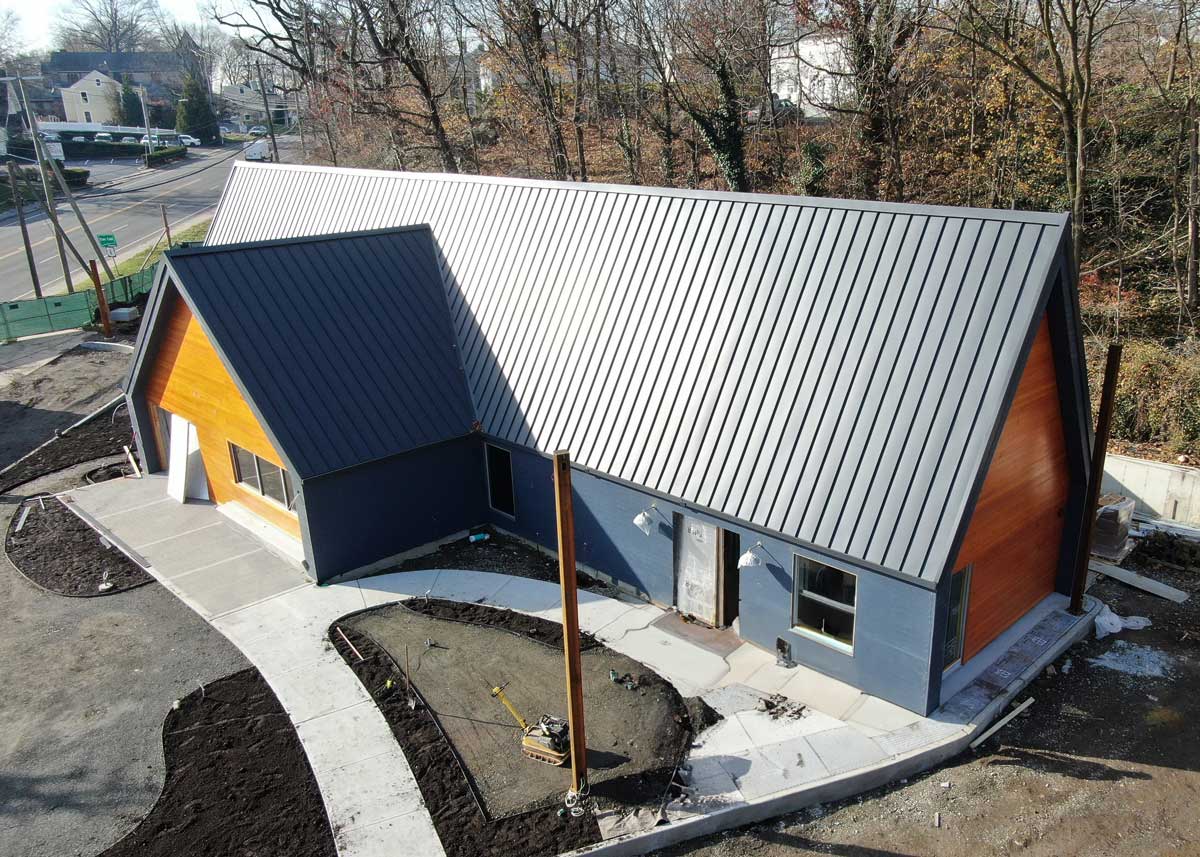
For most Dallas-Fort Worth houses, the steel vs aluminum metal roof question has a short answer: 24-gauge Galvalume steel. It costs less, dents less in hail and moves less in summer heat. Aluminum earns its higher price in a handful of specific cases, and this guide shows you which ones.
We form both metals on our own roll-forming equipment. Our standing seam panels run in 26, 24 and 22 gauge steel on a Galvalume substrate, and in .032″ and .040″ aluminum. Both take the same PVDF paint systems. So this is not a pitch for one metal. It is how the people who bend the panels choose between them.
What is the difference between steel and aluminum roofing?
Steel roofing is a steel sheet protected by a metallic coating and then painted. Aluminum roofing is solid aluminum alloy that protects itself with a thin oxide skin. That one difference drives everything else: strength, corrosion, heat movement and price.
Most residential steel panels use Galvalume, a coating of about 55 percent aluminum with the balance mostly zinc. The aluminum acts as a barrier, and the zinc sacrifices itself at scratches and cut edges. The 2021 International Residential Code, Chapter 9 lists this coating at AZ50 as the minimum for steel roof panels. The same code sets a 0.024-inch floor for roll-formed aluminum panels, so our .032″ and .040″ sheets sit well above it.
| Factor | 24-gauge Galvalume steel | .032″ or .040″ aluminum |
|---|---|---|
| What protects it | Aluminum-zinc coating plus PVDF paint | Natural oxide layer plus PVDF paint |
| Hail dents | Stiffer and harder, so it resists dents better | Softer; dents more easily, .040″ less than .032″ |
| Heat movement | Baseline | About twice as much as steel |
| Weight (standing seam) | About 85-120 lb per 100 sq ft | About 70 lb per 100 sq ft |
| Raw material cost | Lower | Much higher |
| Near salt water | Substrate warranties usually exclude coastal sites | The usual coastal choice |
| Finish warranty on our panels | 30 years on solid PVDF colors, 20 on metallics | Same terms as steel |
| Best fit in DFW | Most homes, especially in hail-prone areas | Curved, formed and architectural work |
The weights are manufacturer figures from Englert’s comparison of roofing materials. The finish terms come from the coil-coater warranties printed on our own spec sheets.
Which metal resists Texas hail better?
Steel does. Steel is roughly three times stiffer than aluminum, and roofing-grade steel is also harder to dent. A .032″ aluminum panel is thicker on paper than 24-gauge steel. Yet it usually dents more easily from the same hailstone. Moving up to .040″ aluminum narrows that gap without closing it.
Keep impact ratings in perspective. Texas carriers give credits for roofing that passes UL 2218, and the Texas Department of Insurance explains that each company sets its own discount for each class. That test looks for cracks and ruptures, not dents. A dented roof can still be watertight, but many Texas policies now carry cosmetic-damage exclusions for hail. Stiffer steel keeps the roof looking right when a claim may not pay for looks.
Does aluminum outlast steel in Texas?
Only where salt is the main threat. McElroy Metal notes that Galvalume substrate warranties exclude buildings within about 1,500 feet of the coast. That is why aluminum dominates true seaside work. Dallas-Fort Worth sits roughly 250 miles inland, and our rain, humidity and heat are well within what Galvalume is built for.
Inland, the paint does most of the work. Our PVDF finishes (Kynar 500 and Hylar 5000) carry the same coil-coater warranties on steel and aluminum: 30 years for solid colors and 20 years for metallics. Low-gloss Kynar colors on our mechanical lock sheets carry 35 years. The exact terms are on our warranties page.
Each metal has a few things to avoid. Manufacturers warn against bare Galvalume touching copper, lead, wet concrete or treated lumber, and against copper runoff draining onto it. Aluminum should not touch copper or bare steel, and it needs stainless or other compatible fasteners. We match trim, clips and fasteners to the metal on the roof.
How do steel and aluminum handle 100-degree summers?
Aluminum grows and shrinks about twice as much as steel for the same temperature change. Panel maker PAC-CLAD puts it at about 7/16″ for a 30-foot aluminum panel over a 100-degree swing, versus about 1/4″ for steel. A roof in July sun runs far hotter than the air, so DFW panels cycle hard every day.
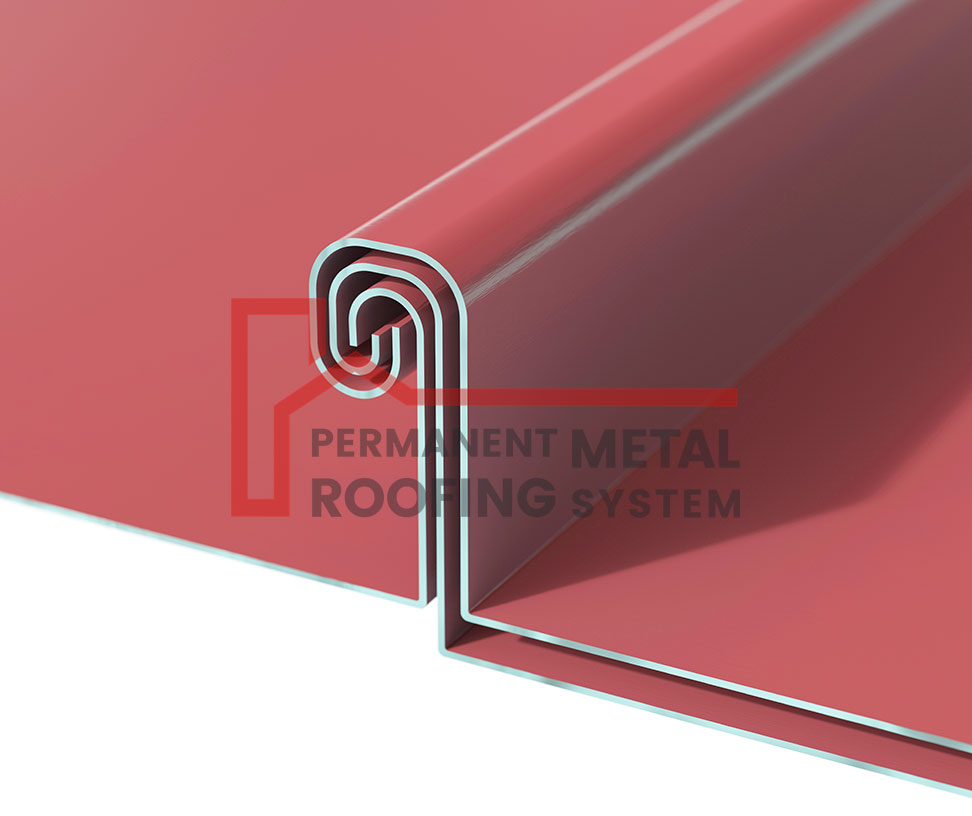
That movement is manageable when the system is designed for it. Concealed clips hold the panels down while letting them slide. A standing seam roof normally has one fixed point and floating clips everywhere else, plus trim details that leave room to move. We stock fixed and floating clips in galvanized and stainless steel.
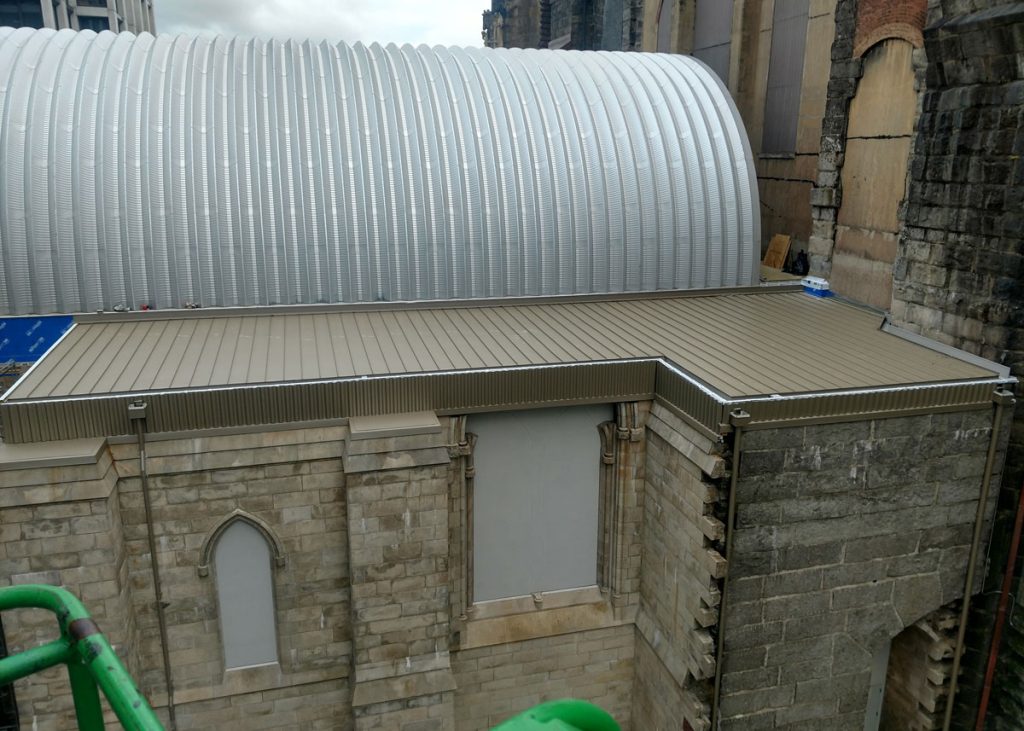
On long aluminum runs, we set the fixed point and expansion details in the shop drawings before the coil goes on the machine. One past PMRS roof shows how far this can go. It was a double-locked 1.5″ mechanical lock system in .032″ aluminum, with panels about 100 feet long in Charcoal Gray, Silver Metallic and Regal White.
Is aluminum lighter, and does the weight matter?
Yes, but both metals are light. Englert lists steel standing seam at about 85 to 120 pounds per 100 square feet and aluminum at about 70. Asphalt shingles run about 275 to 425 pounds for the same area. Either metal weighs far less than the shingles it replaces.
Weight matters most when a new roof goes over an old one, or when the framing is old or undersized. If you are weighing an overlay, read our guide to a metal roof over shingles first.
How much more does an aluminum roof cost?
Aluminum costs noticeably more. McElroy Metal estimates aluminum substrate at 80 to 100 percent more than Galvalume substrate. That premium applies to the raw sheet, so the installed gap shrinks once labor, underlayment and trim are added.
Our live price for a 24-gauge Galvalume roof with a Kynar 500 finish, installed on a house, is about $15 per square foot of roof, as of October 2026. Aluminum depends on thickness, color and roof shape, so we quote it per project. You can model a steel roof in the metal roof cost calculator.
When does aluminum make sense on a DFW roof?
Aluminum makes sense when its softness becomes an advantage or its weight matters. These are the jobs where we reach for it:
- Curved, rolled or heavily formed work, such as barrel roofs, turrets and mansards.
- Flat lock panels and diamond panels for walls, bays and accents.
- Tedlar PVF film finishes. A past PMRS retail roof used .032″ aluminum in matte black Tedlar on a 1.5″ snap lock profile.
- Owners who want the lowest possible weight or need to match existing aluminum elements.
For everything else, especially a whole-house roof under DFW hail, we steer homeowners toward 24-gauge Galvalume. On commercial and long-span jobs, 22-gauge adds more stiffness. Our 24 vs 26 gauge comparison explains that choice in detail.
What this means for DFW homeowners
Start with 24-gauge Galvalume steel and a PVDF finish, and switch to aluminum only for a clear reason. Steel handles hail better, costs less and gives you more panel for the money. Aluminum is a specialty metal that shines on curves, accents and coastal homes. Before you sign, check these points on every bid:
- Which substrate and thickness the bid uses. “Metal roof” alone tells you nothing.
- Whether the finish is PVDF or SMP, since the color warranties differ.
- For aluminum, how the installer handles expansion on long runs.
- For either metal, clips, fasteners and trim that suit that metal.
- Whether the panels are hail-tested, and what your carrier accepts for a credit.
Want to compare profiles next? Our standing seam systems page covers snap lock and mechanical lock options. The PVDF finish guide covers color and fade in Texas sun.
Steel and Aluminum Roofing FAQ
Is steel or aluminum better for a metal roof in Texas?
For most inland Texas homes, steel is the better value. A 24-gauge Galvalume panel with a PVDF finish resists hail dents better, moves less in heat and costs less than aluminum. Aluminum is worth its premium for coastal property, curved or heavily formed work, and some architectural accents.
Does an aluminum roof rust?
Aluminum does not form red rust. It protects itself with a thin oxide layer, which is why it is the usual choice near salt water. It can still corrode where it touches copper or bare steel, so the trim, clips and fasteners on an aluminum roof must be compatible with it.
Will a Galvalume steel roof rust in DFW humidity?
Not under normal inland conditions. The aluminum-zinc coating shields the steel, and the zinc protects scratches and cut edges. With a PVDF finish, a Galvalume roof is built for decades of North Texas rain and humidity. Keep it away from copper runoff, wet concrete and treated lumber.
Can steel and aluminum be used on the same roof?
Yes, with care. The two metals should not touch where water can bridge them, and the fasteners must suit both. Aluminum gutters on a steel roof and aluminum accent panels beside steel standing seam are common examples. We plan separators and fasteners for those junctions before fabrication.
Do steel and aluminum roofs carry the same paint warranty?
On our panels, yes. The PVDF coil-coater warranties printed on our spec sheets are 30 years for solid Kynar 500 or Hylar 5000 colors and 20 years for metallics, on steel or aluminum. Substrate warranties differ, and the PMRS workmanship warranty is separate, so check the warranties page for terms.
Steel or aluminum?
Get Your Roof Priced in the Right Metal
We form steel and aluminum panels in-house, so we can price your roof both ways and show you the difference in writing.