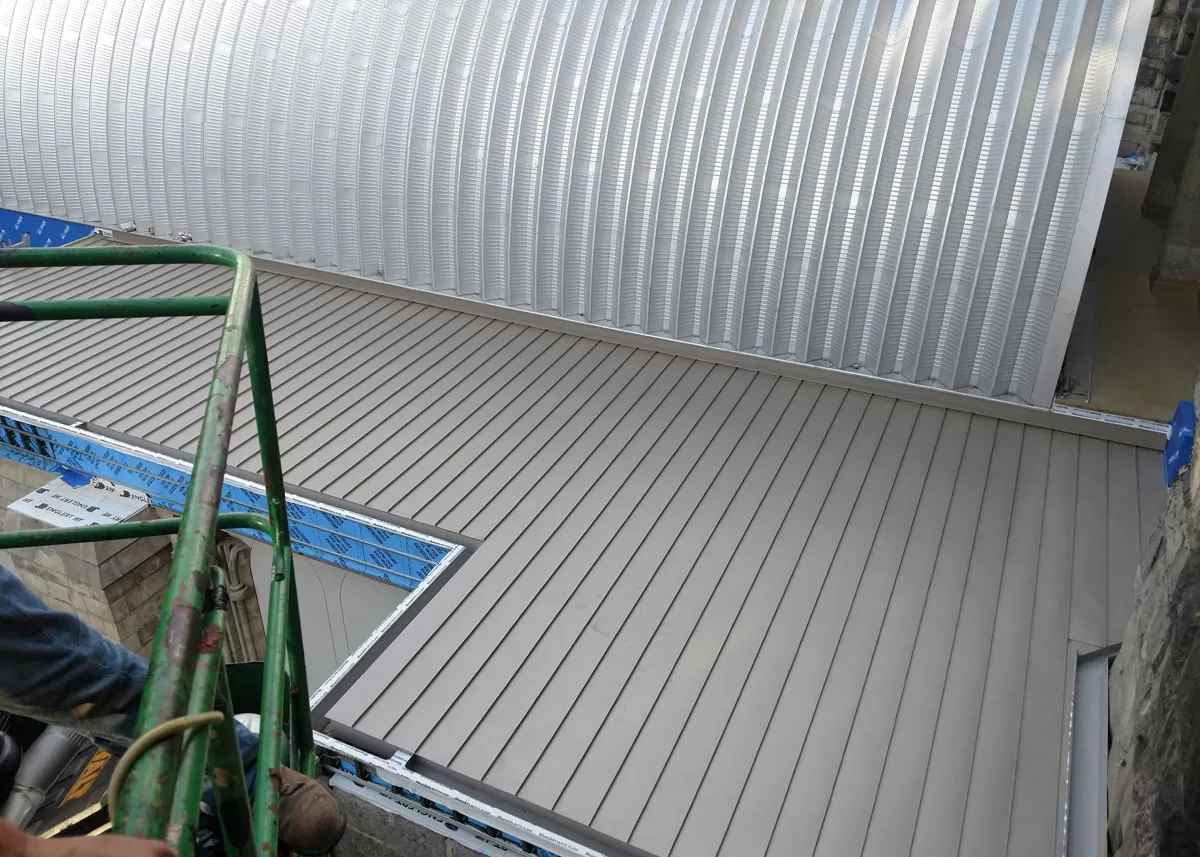
Snap lock vs mechanical lock comes down to roof slope, wind exposure and budget. Snap lock panels click together over concealed clips and suit most Dallas-Fort Worth homes with a pitch of 3/12 or steeper. Mechanical lock panels are folded shut on the roof with a seaming tool. That lets them go down to a 1/2:12 slope and gives the most wind and water resistance.
Permanent Metal Roofing Systems forms both seam types on its own roll-forming equipment. This guide compares them using the specs printed on our own panel sheets, then explains which one fits a typical DFW roof.
How Does a Snap Lock Seam Work?
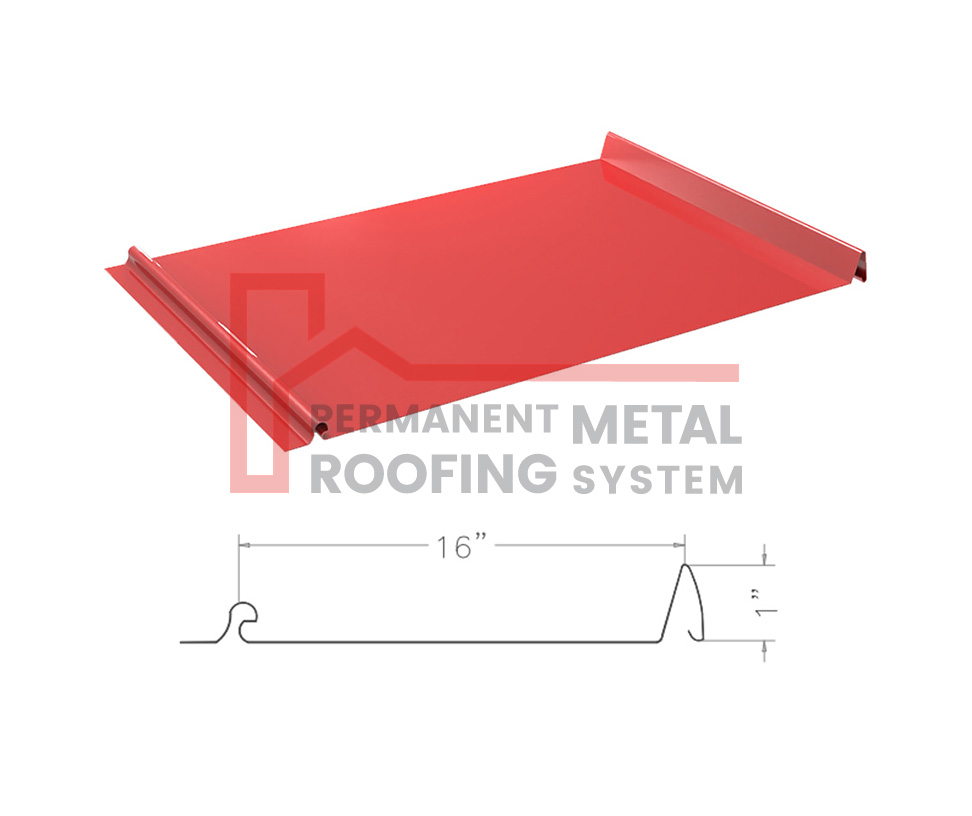
Each snap lock panel has a male leg on one edge and a female leg on the other. The installer screws clips to the deck along one leg, sets the next panel over it, and presses the seam closed. On our 1.5-inch panel, a narrow batten-cap seam snaps over a rigid, continuous leg. No seaming machine is needed.
Speed is the main advantage. Snap lock goes on faster, needs less specialized equipment and usually costs less than a mechanically seamed roof. The trade-off is that the seam relies on its shape, not a fold, to stay closed. That is why snap lock panels are limited to roofs steep enough to drain water quickly.
How Does a Mechanical Lock Seam Work?
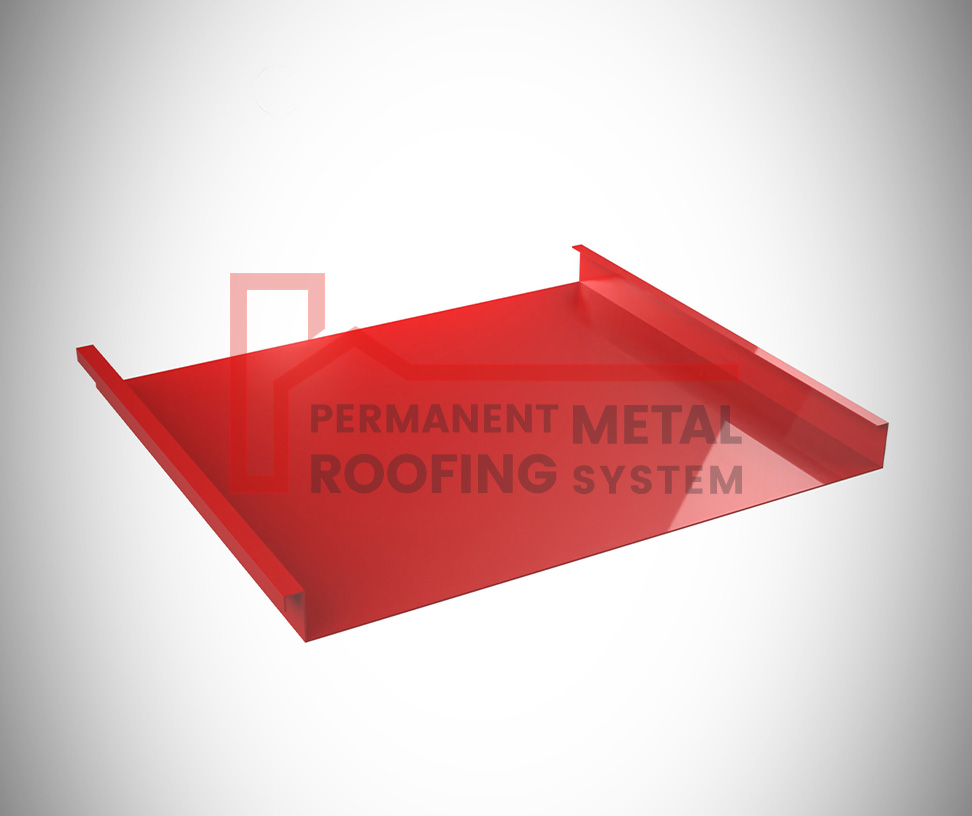
A mechanical lock panel arrives with open legs. After the panels and clips are set, a powered seaming tool runs the length of each seam and folds the legs together. One fold makes a 90-degree, or single lock, seam. A second fold makes a 180-degree, or double lock, seam. Our 2-inch panel also offers a 45-degree option.
The fold locks the clip inside the seam. That gives mechanical lock panels higher uplift resistance and better water resistance than snap lock. It also adds labor, because every seam gets a pass with the seamer after the panels are down.
PMRS Snap Lock and Mechanical Lock Specs Side by Side
These figures come from our panel spec sheets. Panel widths are variable within each range, so we can tune the seam spacing to the look you want.
| Panel | Seam height | Panel width | Minimum slope | Materials | Best for |
|---|---|---|---|---|---|
| 1″ snap lock | 1″ | Typically 12″ to 16″ | 3/12 | Ask for the current spec | Low, crisp residential seam |
| 1.5″ MD snap lock | 1-1/2″ | 12″ to 20″ | 3/12 | 26, 24, 22 ga steel; .032″ and .040″ aluminum | Homes and light commercial |
| 1.75″ MD snap lock | 1-3/4″ | 12″ to 18″ | 3/12 | 26, 24, 22 ga steel; .032″ and .040″ aluminum | Most popular; solid deck or open framing |
| 1″ LD mech lock | 1″ | 12″ to 20″ | 1/2:12 | 26, 24 ga steel; .032″ aluminum; 16 oz copper; zinc | Residential and light commercial, low slopes |
| 1.5″ HD mech lock | 1-1/2″ | 12″ to 20″ | 1/2:12 | 26, 24 ga steel; .032″ aluminum; 16 oz copper; zinc | Heavy-duty residential and commercial |
| 2″ mech lock | 2″ | 12″ to 18″ | 1/2:12 | 26, 24, 22 ga steel; .032″ and .040″ aluminum; 16 and 20 oz copper; zinc | Metal buildings; solid deck or open framing |
Download the sheets: 1.5″ MD snap lock (PDF), 1.75″ MD snap lock (PDF), 1″ LD mech lock (PDF), 1.5″ HD mech lock (PDF) and 2″ mech lock (PDF). The zinc on mechanical lock panels is .7 or .8 mm Rheinzink.
Every profile can be ordered with optional ribs or striations, which reduce visible oil canning. Finishes include Kynar 500 and Hylar 5000 PVDF, SMP and Galvalume Plus, each with its own coil-coater finish warranty.
Start With Your Roof Slope
Slope is the first filter, and it often settles the question. All three PMRS snap lock panels need at least 3/12, meaning the roof rises 3 inches for every 12 inches it runs. On flatter roofs, water moves slowly enough that a snapped seam can let it in.
Our mechanical lock panels are rated down to 1/2:12. That makes them the choice for low-slope porches, patio covers, additions and many commercial roofs. At 3/12 and under, the spec sheets call for high-temperature Pro HT underlayment beneath the panels. The 1-inch and 1.5-inch mech lock panels also require a solid deck.
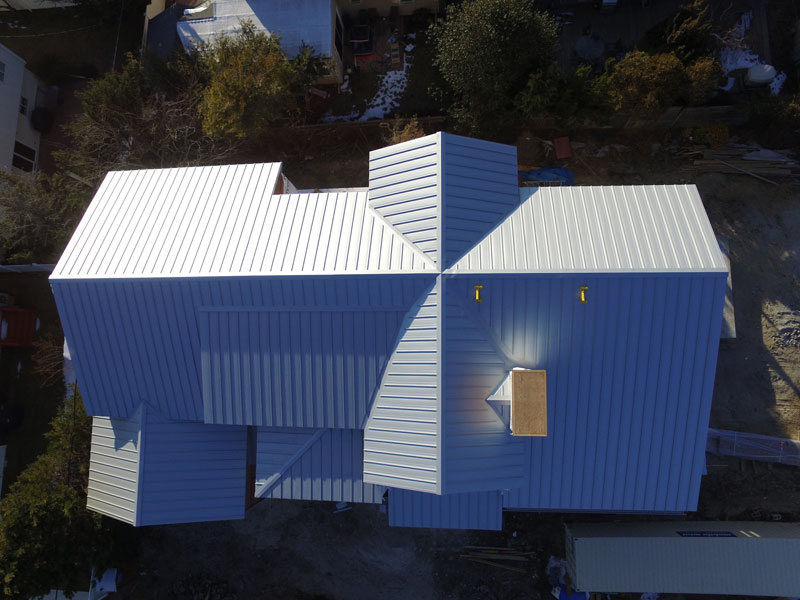
Plenty of homes mix slopes, such as a steep main roof over a shallow back porch. In that case we can run snap lock on the main roof and mechanical lock on the porch, in the same metal and color.
Wind Uplift and Water: Where Mechanical Seams Earn Their Price
Wind lifts a roof from the edges, and a seam is only as strong as whatever holds it closed. A folded mechanical seam traps the clip inside a locked joint, so it resists uplift better than a snapped seam. A double lock seam goes further and is the usual pick for the highest wind exposure.
Roof assemblies are rated for uplift in lab tests such as UL 580, which applies positive and negative pressure to a full roof sample. A rating belongs to a specific panel, clip, clip spacing and deck. Ask for the tested assembly when a project has uplift requirements. We offer site-specific engineering on request.
Water is the other half. All PMRS standing seam roofs carry our Lifetime Non-Prorated Limited Warranty on material and labor. A weather-tightness warranty is the extra layer, and it is reserved for mechanically seamed systems that are seamed to spec. See our warranties page for terms.
On the 1.75-inch snap lock and the 2-inch mech lock, the spec sheets call for seam sealant when a project specifies air and water testing. The 1.75-inch panel also comes with a factory sealant bead in the seam.
How Do Cost and Installation Time Compare?
Snap lock usually costs less. It installs faster, the clips are simpler and no seaming pass is needed. Mechanical lock adds labor for seaming, and the taller profiles use more metal per square foot of roof.
Our published installed price for 24-gauge Galvalume standing seam with a Kynar 500 finish is $15 per square foot of roof, last updated October 2026. Seam type, panel size, gauge and slope all appear as line items on your written estimate. The metal roof cost page explains what moves the price.
Which Standing Seam Fits Your Roof?
Choose snap lock if:
- Every roof plane is 3/12 or steeper.
- You want a clean residential look at a lower installed cost.
- The house sits in a typical suburban wind exposure with no engineered uplift requirement.
- You are roofing in steel or aluminum.
Choose mechanical lock if:
- Any part of the roof is below 3/12.
- The site has high wind exposure or the plans call for a tested uplift rating.
- You want a weather-tightness warranty.
- You want copper or zinc, which we form in mechanically seamed profiles.
- The structure is a metal building or open-framed, where the 2-inch panel shines.
What This Means for DFW Homeowners
Most steep-slope DFW homes fit snap lock well. That is a big reason the 1.75-inch snap lock is the system our spec sheet calls the company’s most popular. Mechanical lock earns its extra cost on low porches, patio covers, commercial roofs and high-exposure sites.
Hail does not change the answer much. Dent resistance depends far more on metal thickness than on seam type. A 24-gauge panel is about 28 percent thicker than 26-gauge, which is why we recommend it in hail country. Read 24 vs. 26 gauge metal roofing for the numbers.
Heat matters more than people expect. North Texas swings from 100-degree afternoons to hard freezes, and long panels grow and shrink with every swing. Both seam types use concealed clips, and floating clips on long runs let each panel slide without stressing its fasteners. Good clip layout and striations also help limit oil canning.
If your HOA reviews the plan, the seam type rarely matters to the board. At the same seam height, the two systems look much alike from the street. Solar clamps are made for both, so confirm the clamp model with your solar installer.
Explore the full lineups on our snap lock and mechanical lock pages, or start with the standing seam overview. Builders can find every sheet in our downloads library.
Snap Lock and Mechanical Lock Questions
Is mechanical lock better than snap lock for hail?
Not in any meaningful way. Hail resistance depends mostly on the metal, its thickness and the finish, not on how the seam closes. A 24-gauge panel resists dents better than a 26-gauge panel with either seam. Both seam types can be part of a UL 2218 Class 4 rated assembly when the specific product has been tested.
Can snap lock panels be used on a low-slope porch?
Not below 3/12. Our snap lock spec sheets set 3/12 as the minimum slope, because water moves too slowly on flatter roofs for a snapped seam. For porches and patio covers below that pitch, we use mechanical lock panels rated down to 1/2:12, with high-temperature underlayment beneath them.
What is the difference between single lock and double lock?
A single lock seam is folded once, to 90 degrees. A double lock seam is folded twice, to 180 degrees, so the legs wrap around each other and the clip. Double lock gives the most uplift and water resistance and is the usual choice for low slopes and high-wind sites. Single lock seams a little faster and keeps a slimmer seam profile.
Can I mix snap lock and mechanical lock on one house?
Yes. Many homes have a steep main roof and a shallow porch or addition. We can run snap lock where the slope allows and mechanical lock on the low sections, in the same metal and color. The trim and flashing where the two areas meet are bent in our shop to fit that roof.
Which PMRS standing seam is the most popular?
Our 1.75-inch MD snap lock, which its spec sheet calls the company’s most popular system. It pairs the look of an architectural panel with the extra spanning and uplift capacity of a structural one. It can go over a solid deck or open framing, in steel or aluminum. See the 1.75-inch snap lock page.
Spec Sheets and Free Estimates
Not Sure Which Seam Your Roof Needs?
We will measure the slope, check the deck and recommend a panel in writing. Builders and architects can request shop drawings and submittals.